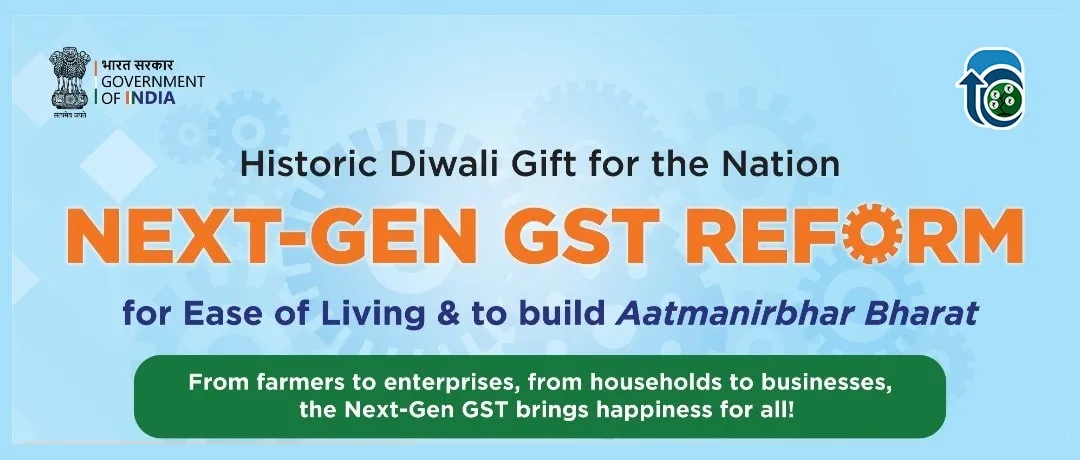

Next-Gen GST Reform 2025 : The Government of India has announced a historic Diwali gift for the nation – the Next-Gen GST Reform 2025. With a strong vision to make life easier for citizens and to build Aatmanirbhar Bharat, the reform brings major relief in tax rates across essentials, healthcare, education, agriculture, automobiles, and electronics. This bold step ensures affordability for common households, farmers, students, and businesses, while giving a new boost to the economy.
The Goods and Services Tax (GST), introduced in 2017, was one of India’s biggest tax reforms. By unifying indirect taxes under one umbrella, it simplified compliance and created a seamless market. However, over the years, concerns around complex procedures, high tax burden on essentials, and refund delays emerged.
The Next-Gen GST Reform 2025 addresses these challenges. It reduces taxes on essentials, brings relief to healthcare and education, boosts automobile and electronics sectors, and introduces MSME-friendly process reforms. More importantly, it aims to balance economic growth with citizen welfare.
This ultimate guide will take you through every aspect of the reform – from household essentials to MSMEs, from case studies to FAQs – to help you understand its full impact.
1. Next-Gen GST Reform 2025: Introduction & Impact on Daily Essentials
A Historic Diwali Gift for the Nation
The Government of India has rolled out the Next-Gen GST Reform 2025, calling it a historic Diwali gift for every Indian household. With the vision of building an Aatmanirbhar Bharat, this reform focuses on making everyday living more affordable while boosting the economy.
GST (Goods and Services Tax) was first implemented in July 2017 to bring India under a “One Nation, One Tax” system. Over the years, it simplified taxation but also faced criticism for high rates on essentials. The Next-Gen GST Reform addresses these concerns by slashing GST rates on daily needs, healthcare, education, agriculture, and automobiles.
This is not just a tax cut – it’s a strategic reform that aims to:
- Reduce the financial burden on middle-class families
- Strengthen farmers and MSMEs
- Support healthcare and education access
- Promote sustainable growth
Saving Big on Daily Essentials
One of the biggest highlights of the reform is the drastic reduction of GST on daily essentials. For instance, from personal care products to kitchen items, many goods now attract just 5% GST instead of the earlier 12–18%.
Key Changes in Essentials GST Rates:
| Item | Previous GST Rate | New GST Rate |
|---|---|---|
| Hair Oil, Shampoo, Toothpaste, Toilet Soap Bar, Tooth Brushes, Shaving Cream | 18% | 5% |
| Butter, Ghee, Cheese & Dairy Spreads | 12% | 5% |
| Pre-packaged Namkeens, Bhujia & Mixtures | 12% | 5% |
| Utensils | 12% | 5% |
| Feeding Bottles, Napkins for Babies & Clinical Diapers | 12% | 5% |
| Sewing Machines & Parts | 12% | 5% |
What Does This Mean for Households?
For a middle-class family, this reform translates to direct savings every month. Consider this example:
- A family spends ₹2,000 per month on essentials like soaps, shampoos, toothpaste, and dairy products.
- Earlier, they paid 12–18% GST (₹240–₹360 tax).
- Now, with GST at just 5%, their tax outgo reduces to ₹100.
That’s a savings of ₹140–₹260 every month, or up to ₹3,000 a year – just from daily essentials.
Why This Matters
This reform ensures that:
- Basic hygiene products become affordable for every family, improving public health.
- Nutritious dairy products like ghee and cheese reach more households.
- Working-class families spend less on essentials and save more.
- Women & children benefit directly with reduced costs on personal and baby care products.
Economic Impact of Essentials GST Reform
Lowering taxes on daily essentials will:
- Boost Consumption – When products become cheaper, demand rises.
- Increase Formal Market Participation – Branded and GST-compliant products will see higher sales compared to unorganized sector goods.
- Support FMCG Growth – Fast Moving Consumer Goods (FMCG) companies will benefit from higher volumes.
- Improve Household Savings – More disposable income means more money for investments, education, or healthcare.
2. Next-Gen GST Reform 2025: Uplifting Farmers & Agriculture
The Agriculture at the Heart of the Nation
Agriculture has always been the backbone of India’s economy, employing nearly 50% of the population and contributing significantly to GDP. However, farmers have long faced challenges of high input costs, low productivity, and shrinking profits.
The Next-Gen GST Reform 2025 provides much-needed relief by lowering taxes on essential farming equipment and supplies. As a result, it not only reduces costs but also empowers farmers to adopt modern techniques, thereby boosting production and income.
Key GST Reductions for Farmers
Under the new GST structure, multiple agricultural products and machinery have seen a sharp reduction in tax rates:
| Item | Previous GST Rate | New GST Rate |
|---|---|---|
| Tractor Tyres & Parts | 18% | 5% |
| Tractors | 12% | 5% |
| Specified Bio-Pesticides & Micro-Nutrients | 12% | 5% |
| Drip Irrigation Systems & Sprinklers | 12% | 5% |
| Agricultural, Horticultural & Forestry Machines for Soil Preparation, Cultivation, Harvesting & Threshing | 12% | 5% |
This tax reduction ensures that farming inputs become more affordable, directly improving farmer profitability.
Benefits of the Reform for Farmers
1. Cheaper Machinery for Modern Farming
Tractors and essential parts, which once attracted 12–18% GST, now come under 5% GST. For small and marginal farmers, this is a game-changer. Machinery like soil preparation tools, harvesting equipment, and threshers will now be available at lower prices, encouraging wider adoption.
2. Promoting Sustainable Farming
The reduction in GST on bio-pesticides and micro-nutrients supports eco-friendly and sustainable agricultural practices. Farmers can now shift from chemical-heavy farming to more organic and soil-friendly alternatives at affordable costs.
3. Boost to Irrigation Infrastructure
Water scarcity is one of the biggest challenges in Indian farming. With drip irrigation and sprinkler systems now under just 5% GST, farmers can set up cost-effective irrigation systems, leading to:
- Better water management
- Higher crop yield
- Reduced dependency on monsoons
4. Encouraging Rural Development
Affordable agricultural equipment will help increase mechanization in villages. This means faster farming operations, better productivity, and more job opportunities in rural areas.
Case Study: Farmer’s Savings After GST Reform
Consider a farmer who plans to buy:
- A tractor costing ₹6 lakh
- Tractor tyres worth ₹40,000
- Drip irrigation kit worth ₹25,000
Before the reform:
- Tractor (12% GST) = ₹6,72,000
- Tyres (18% GST) = ₹47,200
- Irrigation kit (12% GST) = ₹28,000
Total = ₹7,47,200
After the reform:
- Tractor (5% GST) = ₹6,30,000
- Tyres (5% GST) = ₹42,000
- Irrigation kit (5% GST) = ₹26,250
Total = ₹6,98,250
👉 The farmer saves ₹48,950 just due to lower GST rates. That’s nearly the cost of seeds and fertilizers for an entire season!
Economic Impact on the Agriculture Sector
- Lower Costs, Higher Profits: Farmers retain more income, improving rural purchasing power.
- Boost to MSMEs: Local tractor and irrigation equipment manufacturers will see higher sales.
- Increase in Exports: Cheaper farming inputs lower production costs, making Indian crops more competitive globally.
- Strengthening Aatmanirbhar Bharat: By making modern farming affordable, India reduces dependency on foreign imports of food and agro-products.
3. Next-Gen GST Reform 2025: Relief in Healthcare & Education
Building a Healthier & Smarter India
Healthcare and education are two pillars of a strong nation. Nevertheless, for years, high GST rates on medicines, insurance, and stationery added to the financial burden of families.
This reform ensures that quality healthcare becomes affordable and education more accessible. For millions of families, this is not just tax relief – it’s hope for a better future.
Healthcare Relief: Making Medical Care Affordable
India’s healthcare system faced its toughest test during the pandemic, when the cost of oxygen, medicines, and hospital care became a national concern. Recognizing this, the GST Council has reduced or removed taxes on critical healthcare services and products.
Key GST Reductions in Healthcare:
| Item | Previous GST Rate | New GST Rate |
|---|---|---|
| Health Insurance | 18% | 5% |
| Oxygen, Oxygen Concentrators, Oxygen Cylinders | 12% | 5% |
| Diagnostic Kits & Laboratory Services | 12% | 5% |
| Spectacles & Lenses | 12% | 5% |
| Hearing Aids | 5% | 0% (Nil GST) |
| Life-Saving Medicines & Vaccines | 5% | 0% (Nil GST) |
Benefits for Families
- Affordable Health Insurance: With GST down from 18% to 5%, more families can now secure insurance coverage at lower premiums.
- Cheaper Diagnostics: Routine tests like blood work, X-rays, and scans now cost less, encouraging preventive healthcare.
- Accessible Vision & Hearing Care: Spectacles and hearing aids are now more affordable, improving quality of life for millions.
- Zero GST on Life-Saving Drugs: Critical treatments are within reach for low-income families.
👉 Example: A family paying ₹20,000 annually for health insurance earlier paid ₹3,600 as GST. Now, under 5% GST, they pay just ₹1,000 – saving ₹2,600 annually.
Education Relief: Knowledge Without Tax Burden
Education is the foundation of growth, yet costs often hold back students. By cutting GST on books, stationery, and learning tools, the reform ensures that no child is left behind.
Key GST Reductions in Education:
| Item | Previous GST Rate | New GST Rate |
|---|---|---|
| Books (Educational & Children’s) | 12% | 0% (Nil GST) |
| Stationery (Pencils, Erasers, Sharpeners, Notebooks) | 12% | 0% (Nil GST) |
| Maps & Atlases | 12% | 0% (Nil GST) |
| Educational Services (E-learning, Digital Content) | 18% | 5% |
Benefits for Students & Families
- Affordable Learning: With books and stationery now tax-free, students can access knowledge without added costs.
- Boost to Digital Learning: Reduced GST on e-learning platforms promotes Digital India and online education.
- Support for Schools & Colleges: Lower input costs on learning materials reduce operational expenses for institutions.
👉 Example: A student buying stationery worth ₹1,000 earlier paid ₹120 as GST. Now, with nil GST, that money can go towards additional books or online courses.
Wider Impact on Society
- Improved Healthcare Access: More families will seek preventive care, reducing long-term healthcare costs.
- Education for All: Lower costs will encourage higher school enrollment and better literacy rates.
- Stronger Workforce: Affordable education + healthier citizens = a more productive nation.
- Boost to Insurance Industry: Lower premiums will expand coverage, reducing the burden on public healthcare.
4. Next-Gen GST Reform 2025: Automobiles & Electronics Made Affordable
A Big Boost for Middle-Class Families
Automobiles and electronics are no longer luxuries – they are essentials for modern living. In fact, from two-wheelers for commuting to air conditioners, televisions, and laptops at home, these products form an important part of Indian life.
However, high GST rates (up to 28%) made them expensive for the average household. The Next-Gen GST Reform 2025 brings massive relief by slashing GST rates, making vehicles and appliances more affordable while giving a push to green mobility and digital India.
Automobiles: Driving Affordability & Sustainability
The automobile sector faced one of the highest GST slabs (28%), which discouraged buyers. With the new reform, the government has cut GST to 18% on many vehicle categories.
Key GST Reductions in Automobiles:
| Item | Previous GST Rate | New GST Rate |
|---|---|---|
| Hybrid Cars | 28% | 18% |
| Motorcycles (up to 350cc) | 28% | 18% |
| Three-Wheelers & Goods Transport Vehicles | 28% | 18% |
| Electric Vehicles (EVs) | 12% | 5% |
Benefits for Consumers & Economy
- Affordable Mobility – Two-wheelers and small cars are now cheaper, directly helping students, working professionals, and small business owners.
- Green Future – GST on EVs is now just 5%, promoting eco-friendly transport and reducing fuel dependency.
- Boost to Logistics – Lower GST on goods vehicles reduces transportation costs, bringing down prices of essential goods.
- Support for Automobile Industry – With higher demand, the auto sector gets a strong revival after years of slowdown.
👉 Example: A hybrid car worth ₹10 lakh earlier attracted 28% GST = ₹12.8 lakh total price. Now, at 18% GST, the same car costs ₹11.8 lakh – a direct saving of ₹1 lakh for buyers.
Electronics & Appliances: Comfort Within Reach
The Indian middle class spends heavily on home appliances. However, high GST rates made products like air conditioners, refrigerators, and televisions costly. The reform changes this by lowering GST to 18%.
Key GST Reductions in Electronics:
| Item | Previous GST Rate | New GST Rate |
|---|---|---|
| Air Conditioners | 28% | 18% |
| Dishwashers | 28% | 18% |
| Monitors & TVs (above 32 inches) | 28% | 18% |
| Laptops & Desktop Computers | 18% | 12% |
Benefits for Families
- Affordable Cooling – With GST down, air conditioners and refrigerators become accessible to more families, improving living standards in hot climates.
- Digital Empowerment – Lower GST on computers and monitors supports Digital India and remote learning.
- Modern Lifestyle – Middle-class households can now invest in appliances like dishwashers and smart TVs at lower costs.
👉 Example: A 1.5-ton air conditioner priced at ₹40,000 earlier attracted 28% GST = ₹51,200 final cost. Now, under 18% GST, it costs ₹47,200 – saving ₹4,000 instantly.
Wider Economic Impact
- Rising Consumer Demand – Affordable vehicles and electronics will push demand, helping industries grow.
- Boost to Make in India – Local manufacturers benefit as demand shifts from imports to Indian-made goods.
- Employment Growth – Increased production in auto and electronics industries creates lakhs of jobs.
- Sustainable Development – Lower EV GST promotes adoption of cleaner technology.
5. Next-Gen GST Reform 2025: Simplified Processes & MSME Benefits
Making GST Simple for Businesses
Since its introduction in 2017, the Goods and Services Tax (GST) has been praised for unifying India’s tax system. But for MSMEs (Micro, Small & Medium Enterprises), complex procedures, refund delays, and compliance issues often became major pain points.
The Next-Gen GST Reform 2025 focuses not just on tax rates but also on process reforms. By simplifying GST compliance, the government aims to empower small businesses, boost ease of doing business, and strengthen India’s startup and MSME ecosystem.
Key Process Reforms Under GST 2025
1. Automatic Registration Within 3 Days
Earlier, GST registration sometimes took weeks due to document verification and system delays. Now, businesses can receive automatic GST registration in just 3 working days.
- Faster onboarding for startups
- Quicker compliance for MSMEs
- Encouragement for unregistered businesses to join the formal economy
2. Provisional Refunds for Exporters & MSMEs
One of the biggest complaints from exporters and MSMEs was the delay in refunding Input Tax Credit (ITC). With the new reform:
- Exporters will receive provisional refunds within 7 days of filing claims.
- Balance refund will be cleared after verification.
- This ensures better cash flow management and reduces working capital stress.
3. Zero-Rated Supplies Expanded
Zero-rated supplies earlier applied mainly to exports. Now, under the reform, the scope has been expanded to cover more goods and services. This means:
- More businesses benefit from tax-free transactions.
- Encouragement for Indian companies to compete globally.
- Increased support for Aatmanirbhar Bharat vision.
4. Simplified Return Filing
- Filing GST returns will now be single, consolidated, and easier for MSMEs.
- Small businesses with turnover below a threshold will have quarterly filing options.
- Reduced paperwork and compliance costs mean more focus on growth.
Why MSMEs Benefit the Most
India has over 6.3 crore MSMEs, contributing nearly 30% to GDP and employing millions. Yet, many struggled under the earlier GST regime.
The new process reforms:
- Save Time – Faster registrations and simplified filing free up business owners’ schedules.
- Improve Cash Flow – Quick refunds help MSMEs reinvest profits into growth.
- Reduce Costs – Lower compliance burden means less need for external consultants.
- Encourage Formalization – Easier compliance will bring more small businesses under GST, giving them access to loans and subsidies.
Case Study: A Small Exporter’s Journey
Ravi, a small textile exporter from Surat, faced refund delays of 2–3 months earlier. This often locked up ₹10–15 lakh of his working capital.
With Next-Gen GST Reform 2025:
- He receives provisional refund in 7 days, freeing up cash for raw material purchases.
- Faster turnaround helps him accept larger orders from global clients.
- Reduced compliance costs improve his profit margin.
👉 This reform transforms his business from struggling with cash flow to becoming globally competitive.
Economic Impact of Process Reforms
- Ease of Doing Business: India improves its global rankings by reducing bureaucratic hurdles.
- Boost for Startups: Faster registrations encourage new entrepreneurs to launch businesses.
- Higher MSME Growth: More liquidity leads to job creation and higher GDP contribution.
- Formal Economy Expansion: By reducing compliance stress, more businesses will willingly register under GST.
Overall Conclusion: Next-Gen GST Reform 2025 – A Step Towards Inclusive Growth
The Next-Gen GST Reform 2025 is not just a policy adjustment – it is a milestone in India’s economic journey. By reducing the tax burden on essentials, making healthcare and education more affordable, boosting consumption in automobiles and electronics, and empowering MSMEs with simplified compliance, this reform strikes the right balance between citizen welfare and economic expansion.
For households, it translates into direct savings that can be redirected towards investments, financial security, and a better standard of living. Farmers and MSMEs, it provides much-needed relief and liquidity, enabling them to compete and grow. For industries, it sets the stage for higher demand, production, and job creation. And for the nation, it marks a move toward inclusive growth, stronger consumption, and sustainable economic development.
But the real value of these reforms will be unlocked only if individuals and businesses make the right financial choices with the savings they generate. This is where Dream Funds – Your Financial Advisor in Nashik comes in. From mutual funds to SIPs, tax planning to wealth creation, our mission is to help you Dream Big & Invest Smart so that every rupee saved works harder for your future.
👉 The GST reforms are here. The savings are real. The opportunity is now. Let’s turn these changes into a pathway for financial freedom and long-term prosperity.
FAQs on GST Reform 2025
Will GST on luxury goods reduce?
No, luxury and sin goods will remain taxed at higher rates.
How does it help salaried employees?
They benefit from reduced living costs and higher disposable income.
What about startups?
Simplified registration, refunds, and compliance ease their growth journey.
Will government revenue drop?
Although short-term collections may dip, long-term gains from higher consumption and greater formalization are expected to balance revenue.
Will GST rates on luxury items also be reduced?
No. Luxury goods, tobacco, and sin goods will continue to attract higher GST. The reform focuses on essentials and growth sectors.
How does this benefit salaried employees?
Lower GST on essentials and services reduces living costs, increasing disposable income. Salaried employees can channel these savings into investments.
What about startups and small businesses?
Startups benefit from faster registration, simplified returns, and better refund processes. This reduces compliance headaches and frees up resources for growth.
How should individuals plan finances in light of this reform?
Individuals should:
- Seek advice from financial planners like Dream Funds for smarter financial decisions
- Recalculate monthly budgets with savings from lower GST
- Invest additional surplus in mutual funds, SIPs, or insurance
Will government revenue fall due to lower GST rates?
In the short term, collections may dip slightly. However, higher consumption, formalization of MSMEs, and stronger exports will increase long-term revenue.
How should individuals plan finances now?
Use monthly savings to invest in SIPs, insurance, and retirement planning with guidance from advisors like Dream Funds.